Michigan's collective bargaining
law needs fixing
January 3, 2026
Michigan's
Public Employment
Relations Act (PERA) (Act 336 of 1947 as amended) is not sacred. It
needs to be changed to make sure collective bargaining doesn't interfere with the democratic process. It needs to say that a
collective bargaining agreement that increases costs or that changes a
city ordinance is not final until approved by the city council. Further,
the council's approval must come after a public hearing. In other words,
the city council may reject a collective bargaining agreement, even if
reached in a good faith negotiation.
Former attorney general Frank
Kelley recognized the problem of law-making in a bargaining session.
In an
August 31, 1984 opinion (#6244), Kelley wrote that “public employers
and their affected employees [have] the right to, in effect, negotiate a
statute out of existence . . . through collective bargaining.” He went
on to say "Notwithstanding
my concern in this regard, [my opinion is] constrained by the Supreme
Court's consistent holdings with respect to the dominance of PERA in the
public employment sphere.
The continuation of such predominance is a question for legislative
consideration."
(emphasis mine)
The issue drew attention in East Lansing
recently when changes in a new contract between the city and the police
union put limits on the powers of the city's Independent Police
Oversight Commission (ELIPOC) (see
my story). The latest is that ELIPOC members are no longer allowed
to use police department employees’ names at meetings or in reports. (source)
Ridiculous.
The
Public Employment Relations Act
even had a part in
Lansing's early retirement scandal of 1992,
in which 144 city employees retired with jacked-up pensions and generous
health insurance. A January 11, 1993 State Journal story said
|
|
....when the council tried
to put off the entire deal, it was told that would be an unfair
labor practice, because the Teamsters had negotiated in good
faith.
[Councilwoman Ellen] Beal says now that the whole thing should
have been given more consideration.
The council discussed the plan in two private meetings before
voting on it. Michigan Open Meetings laws allowed the closed
meetings because the topic related to union negotiations....
Council members were told not to discuss the plan with anyone
and any notes they took were collected after each meeting... |
|
Section 15 (1) of PERA
needs a few tweaks to put the people - through their
elected representatives - back in charge:
| |
Sec. 15. (1) A public
employer shall bargain collectively with the representatives of
its employees as described in section 11 and may make and enter
into tentative collective bargaining agreements with
those representatives. Except as otherwise provided in this
section, for the purposes of this section, to bargain
collectively is to perform the mutual obligation of the employer
and the representative of the employees to meet at reasonable
times and confer in good faith with respect to wages, hours, and
other terms and conditions of employment, or to negotiate an
agreement, or any question arising under the agreement, and to
execute a tentative written contract, ordinance, or
resolution incorporating any agreement reached if requested by
either party, but this obligation does not compel either party
to agree to a proposal or make a concession.
Any such
contract, ordinance, or resolution remains tentative until a
public hearing is held and the employer
ratifies the agreement. |
|
Unions aren't going to like it when
they get a favorable agreement in a collective bargaining session then
find out it doesn't mean anything unless the employer's governing
body approves. It didn't take long after PERA - which mandated
collective bargaining - was enacted in 1947 that unions realized that
it didn't guarantee that they would get what they wanted. The Act didn't
require that an agreement be reached. So unions - especially public
safety unions - used other tactics to put the pressure on, such as "'job
actions,' 'blue flu,' and 'work to rule'".
That led to the passage of
Act 312, which provided compulsory arbitration for public safety
workers. (history
here)
Act 312 cannot be fixed. In providing for compulsory arbitration for public safety
workers it, allows an arbitrator appointed by the Michigan Employment
Relations Commission (MERC) to make the final determination in disputes
over wages and other economic issues, and it does so by choosing between
the last offer from each party.
Even though arbitrators must be
qualified and undergo training, they still make bad decisions. I have two examples:
-
The first is
the East Lansing case mentioned above. From
Ayah Imran's story in East Lansing Info:
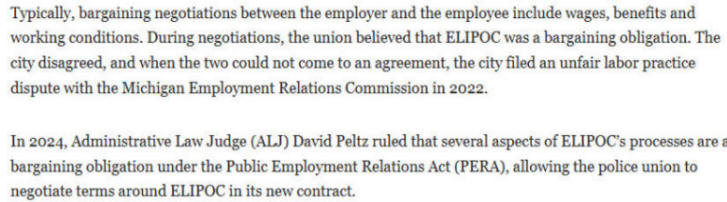
The reason the city did not believe
ELIPOC was not an issue appropriate for arbitration is Section 8 of the
Act, which specifies "economic" issues, not just "issues", although it
does say the arbitration panel decides whether an issue is "economic".:
| |
The arbitration panel shall identify the
economic issues in
dispute and direct each of the parties to submit to the arbitration
panel and to each other its last offer of settlement on each
economic issue before the
beginning of the hearing. The determination of the arbitration panel as
to the issues in dispute and as to which of these issues are economic is
conclusive. The arbitration panel, within 30 days after the conclusion
of the hearing, or within up to 60 additional days at the discretion of
the chair, shall make written findings of fact and promulgate a written
opinion and order. As to each
economic issue, the arbitration panel shall adopt the last offer
of settlement which, in the opinion of the arbitration panel, more
nearly complies with the applicable factors prescribed in section 9. The
findings, opinions and order as to all other issues shall be based upon
the applicable factors prescribed in section 9. |
|
In this case, the arbitrator made a bad decision. There was no way ELIPOC was an
economic issue. We don't know if his error was due to incompetence or
politics. Today's MERC is, after all, part of a Democratic
administration.
-
My second example of a bad decision
coming out of arbitration is from 30 years ago. It was between the
Ingham County Sheriff and the sheriff supervisors, represented by the
Fraternal Order of Police. I wrote a
story about it in 2016. In August 1996, the FOP petitioned MERC
for binding arbitration on several matters, one of which was pensions. The FOP wanted to increase the
pension multiplier from 2.5% to 3.2%. The union promised to pay the full cost as determined
by the actuary, increasing the member contribution from 10.5% to a
whopping 19.61%.
The arbitrator ruled in favor of
the union, but what nobody anticipated was that eight members of the 30-member sheriff supervisor unit
would take advantage of those enhanced retirement benefits without helping pay for
them. They retired within one year, as soon as they were eligible after the October 1,
1997 effective date of the new contract.
Increasing the pension multiplier from
2.5% to 3.2% was a big jump. For a retiree with a $60,000 FAC, the
pension went from $37,500 to $48,000, an increase of $10,500 a
year. A 50 year old male can expect to live to age 82, another
32 years. (life
expectancy calculator) At $10,500 a year, the increase alone would
cost the County $336,000 per retiree. And some of them retired as
young as 45.
(They could retire at any age with 25 years of service.) One of them - Tom Reich, who is now Eaton County sheriff - went to work as an Ingham sheriff deputy the same year he
graduated from high school.
It is not just that MERC arbitrators
make dumb/political decisions. MERC - the state - should not be interfering at all.
All decisions regarding the compensation of local government employees
should be made by the elected representatives of that government. That is democracy.
Act 312 is irredeemable. It should
be repealed.
Send comments, questions, and tips to
stevenrharry@gmail.com or call or text
me at 517-730-2638. If you'd like to be notified by email when I post a
new story, let me know.